Have you ever considered eliminating burnt sienna from your palette? After all, it’s probably one of the most popular earth toned colors found on painters’ palettes. I know it is one of my favorites and for most of my painting career, I always squirted it out of a tube. 
I am not talking about removing the color, I am suggesting that you don’t need to buy tubes of burnt sienna. When I first learned how to mix burnt sienna I was both surprised and thrilled. Even though I knew that the primary colors are the only hues that cannot be mixed, I had never thought about learning how to mix burnt sienna because it was such a regular in my paint box.
The key to knowing how to mix burnt sienna is related to knowing about tertiary colors. Tertiary colors, as I discuss in my post What is the Correct Definition of Tertiary Colors? are the mixtures of two secondary colors. (Tertiary colors are not the colors between a primary and a secondary color.) When orange and purple are mixed, burnt sienna is the result. Viola! Isn’t that cool? Here is one example.

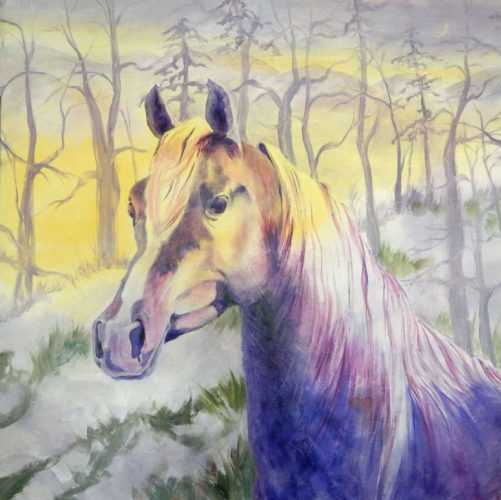
In my post Mixing purple and orange , I demonstrate how I layer purple and orange, as well as mix it, to create a variety of burnt sienna hues. Below shows how I started giving the horse dimension by applying different hues of purple as darks. Then I applied layers of oranges to achieve depth and richer colors in this commission of Machi. Unfortunately, the digital photo does not due justice in showing the variety of browns and chestnuts achieved.
 |
 |
Perhaps there will be situations, such as when painting on location, when you want to carry fewer tubes of paint. Now you can maximize your color mixing potential with fewer paints along with carrying a light load.
In this chart, I have mixed two different oranges with different purples. The top three rows are mixed with one bright orange and three different purples. I mixed different ratios of orange and purple to show the variety that is possible. In the bottom two rows, the orange is a duller hue and mixed with two different purples. When you compare these mixtures with the colors that came out of the tubes above, you can see that burnt sienna is easy to mix.
 Are you willing to eliminate tubes of burnt sienna from your paint box? Try mixing different oranges and purples to see which combinations you prefer. You might find some surprises.
I do know that burnt sienna just might be one of your “convenient colors.” Many of us have certain tubes of paint for this reason….it’s easier or more convenient to squirt the color out versus mixing it. However, I do want to encourage you to give mixing burnt sienna a try. Let me know how it goes.
If you found this information helpful, please share this post with other interested painters.
Gratefully and colorfully yours,
Carol
PS If you want to learn more about mixing color, visit the introductory video to my online course Acrylic Color Mixing Made Easy! produced by Craftsy.


