Hard and soft edges are important elements in your paintings. The most popular way to soften edges is by applying different brush techniques of dragging, zigzagging and overlapping as demonstrated in this video. The other way, which is not employed as often by painters, is by using color and value.
First a quick definition: Hard edges provide a strong sense of where an object begins and ends, whereas soft edges disappear or fade into the background. They are also known as lost and found edges. Hard edges command attention from the viewer because of the sharp contrast, while soft edges bleed together.
Why is it important to utilize the technique of hard and soft edges? It is because they:
- Create variety and energy in a painting;
- Set the tone of your visual message;
- Direct the viewer to the areas of rest as well as the area(s) of focus;
- Demonstrate your mastery of painting.
Using color and value to achieve edge variety is a technique I like to use, particularly in my abstract paintings and those infused with realism. In these paintings, I often have many hard edges but I do not want them to draw immediate attention. I want to maintain the integrity of the edge, while the shapes disappear into the background.
In the painting below, you can see where variety is achieved around the edge of the rectangle. The edge between the background and the textured box is there, yet there is a variation of color and value where the two meet. (Earlier stages of the painting can be seen below.)
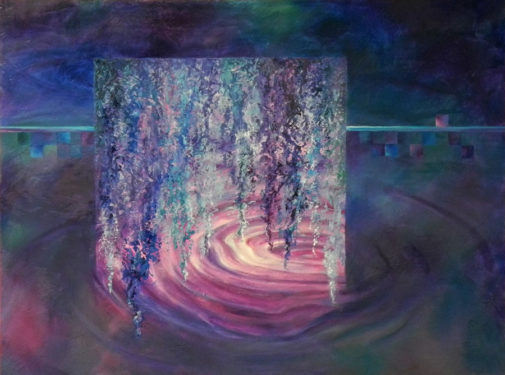
“Veiled,” 18×24 oil on panel
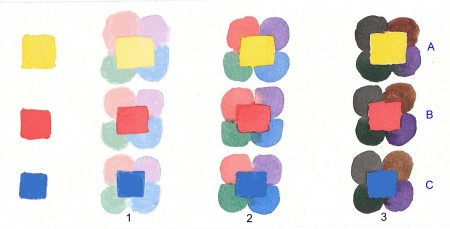
Below is an exercise that I teach in my live color classes. In this example I am using watercolor, but it can be executed in any medium. Students are first asked to choose a yellow, red and blue because they represent light, middle and dark values respectively. They paint 4 swatches of each of these colors as you can see here.
After these primary swatches of color dry, the students are then asked to mix up four different colors – such as red, green, purple and blue — in a light value. These colors are then painted around the first column of primary colors (column 1). A second batch of colors is mixed at middle values and painted around the primary colors in column 2. Then darker values of color are painted in column 3. Fun, eh?
Notice how the edges soften in: 1) Column 1, row A; 2) Column 2, row B; and 3) Column 3, row C. A variety of colors are used, while the same values are maintained in each column.
Conversely, you can also see a high contrast in edges using color and value, in 1) Column 1, row C; and 2) Column 3, row A.
 In the next image, the hard and soft edges are more evident by removing the color via photo software. I took the painted exercise from above and converted it to black and white. Interesting, yes?
Using the earlier painting as an example, here are a couple of earlier stages of “Veiled.” The edges read quite hard almost all away around the rectangle shape.
 Because I apply several layers of paint in my process, I knew that I would be adding colors and values that created a sense of lost and found edges. You can see that begin to develop in the next stage. Notice how the upper left corner almost disappears; this also adds more mystery to the painting.
 And for a close-up view, below is cropped area of the painting. I also played with my use of color and values in the small squares I have ‘hanging’ off of the vertical blue line. (If you would like to see earlier stages of the painting, visit “Veiled,” in my portfolio.

No matter your style or subject matter, hard and soft edges can be employed using brush techniques, as well as being aware of the color and value relationships where edges meet. They play an important role in communicating your visual message, consequently I encourage you to utilize both approaches. If you would like to see more examples of this concept, please visit my Portfolio Page on my web site.
What is your favorite way of softening the edges in your paintings?
As always, if you enjoyed this blog post, please share it.




Hi Suzie, Sorry for my late response. I did not see your comment until now. It is lovely to know that my tips are helping you with your fabrics. I have often wondered if this was the case. Thank you for sharing my information and for letting me know about your journey. It’s always good to hear from a kindred artist. 🙂