As a visual artist, you work on a two-dimensional surface yet you want to create a sense of atmospheric perspective or depth in your painting. By doing so, you are attempting to create an illusion for your viewers. I LOVE tricking my viewers using the principles of creating depth. What are these guidelines that will entice people into your work?

An illusion of depth can be applied to short distances, such as 12 inches, as well as in creating an illusion of infinity. Depth plays a role in all styles of painting, be it an abstract, landscape or sill life. As the creator, it is up to you to apply it. To me it is part of the magic or wonder that we create.
A definition of atmospheric perspective. It is the phrase used to describe our perceptions of objects that are in the distance. The conditions in the atmosphere change as an object or landscape extends far into the distance. These conditions cause objects to change in size, color and texture.
An illusion of depth can be applied to short distances, such as 12 inches, as well as in creating an illusion of infinity. Depth plays a role in all styles of painting, be it an abstract, landscape or sill life. As the creator, it is up to you to apply it. To me it is part of the magic or wonder that we create and it is fun to do.
What are the techniques you can use to achieve the perception of distance?
Breakdown Your Image into Planes of Atmospheric Perspective
Begin by thinking of your paintings as being a theatrical stage with cut-out pieces of scenery. Break down your scene or abstract painting into a foreground, middle ground and background. See the below sketch as an example of that I mean.


Let’s take the above sketch in blues and translate it into a theatrical-like scenario per the sketch above. Below I have crudely broken the simple landscape into a foreground, middle-ground and background.

What are the implications of this information? How can you use this concept into your paintings?
Here’s Your Checklist for Creating Atmospheric Perspective in Your Paintings:
As space recedes —
- Details becomes blurred if not completely lost.
- Edges become gradually softer the further the distance you want to portray.
- Color becomes cooler.
- Color becomes less intense and more de-saturated or neutralized.
- The contrast between shapes and values diminishes.
Painting Tip: One or more of the above principles needs to be exaggerated in every painting to convince the human eye. It is important to overstate at least one, not all. Because you are working on a two-dimensional surface, pushing one of these to a near extreme will be more convincing. In other words, the exaggeration helps to create a little magic in your work.
Additional principles to keep in mind when creating depth are:
- Close objects overlap objects further away.
- Objects/shapes become smaller the farther away they are; this is the principle of linear perspective.
- Line/lines draw viewers into the depth of a painting and/or tap into our visual dictionaries. We immediately interpret them as a familiar three dimensional shape.
Application example: As per the theatrical stage concept I described above, you want to use darker and brighter colors in the foreground of your painting and lighter and duller colors in the background. The middle ground colors would be a gradation between the colors you used in the foreground and background planes.
When you look at greens I applied in my painting “Quiet Reflection” below, you will notice that they are warmer and darker in the foreground. The greens reflected in the water are lighter and duller from these foreground greens. Then in the background they are even more dull as well as bluer and lighter.
As you look at my landscape below, which principles did I employ? Which of the top 5 listed above did I exaggerate?
 Did I create a sense of depth, and quiet? Does it takes you back into the painting and beyond the picture frame? Do you feel the atmospheric perspective?
Use the above checklist as a starting point and experiment to discover your visual voice. Note that most artists forget to exaggerate at all. Hence, they are not as successful in creating an illusion of depth.
Below I provide a graphic example of how to apply the theater stage concept to a still life.

Here I have broken the scene into three planes.
 |
 |
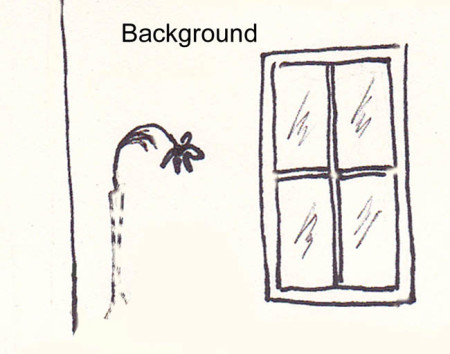 |
Obviously, separating out the three planes – foreground, middle ground and background – is completely up to the creator of the painting and is arbitrary. Abstract painters need to do the same if they are interested in creating depth in their work.
Do you enjoy creating illusions for your viewers? When did you last apply some of the techniques described above or perhaps when might you use them in the future?
I cover these principles in my e-book Creating Depth.
PS Please share this blog post with anyone who is interested in the magic and logic of color. You can use the buttons below.



You are welcome Barb! True, like most skills in painting, it does take practice. Glad to help.
Glad to help Nadya. When I learned this approach, it gave me a lot of clarity and simplified my mixing.